

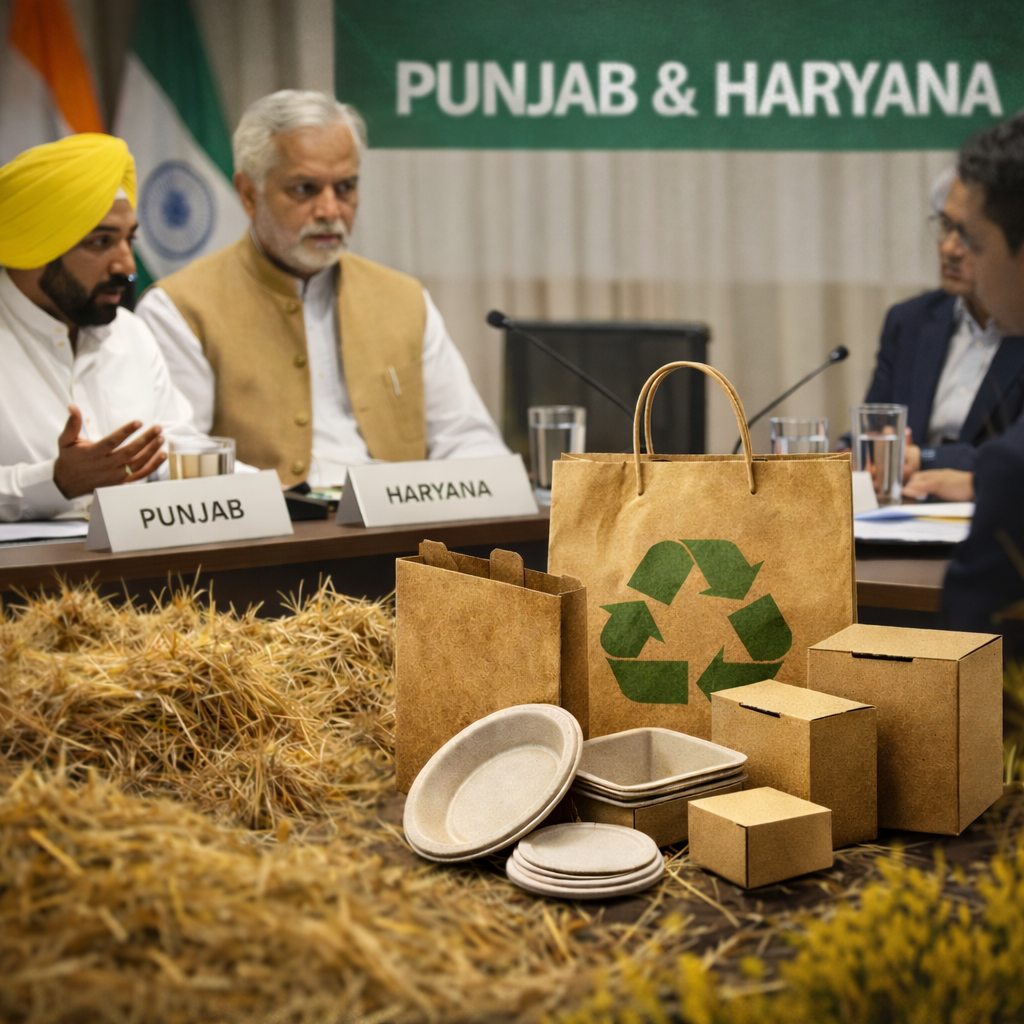
Punjab and Haryana have launched their first regional dialogue to study how crop residue can support low-carbon packaging. The meeting brought together government officials, industry leaders, farmers, brands, and sustainability experts. Together, they explored agri-fibre–based pulp and paper solutions.
Roundtable Sets Focus on Circular Economy
The roundtable, titled “Building Circular, Low-Carbon Supply Chains for Agri-Fibre Pulp and Paper Packaging,” was held at the Hyatt Regency Chandigarh. It was co-presented by Asar and Canopy.
Importantly, the discussion focused on turning paddy straw and wheat straw into eco-friendly packaging materials. As a result, participants addressed issues like air pollution, carbon emissions, and farmer incomes.
Crop Residue Seen as Economic Resource
Punjab and Haryana together generate over 35 million tonnes of crop residue each year. However, much of this biomass remains unused or is burned. This practice causes severe air pollution.
Therefore, speakers highlighted the need to reuse residue as an industrial raw material. Moreover, they stressed that farmers must play an active role in these circular supply chains.
Punjab Highlights Sustainable Residue Management
Gurmeet Singh Khuddian, Punjab’s Agriculture Minister, said the state is working hard on sustainable crop residue management. Accordingly, platforms like this help connect policy, industry, and farmers.
In addition, he noted that India already has the technology to produce pulp and paper from agri residue. Rising demand from e-commerce, FMCG, and retail sectors creates new economic opportunities.
India’s Agri-Fibre Production at Scale
India currently produces around 1.5 million tonnes of pulp and paper from crop residue across 23 mills. This clearly shows that large-scale production is possible.
Meanwhile, agri-fibre paper and corrugated packaging are gaining attention. They help reduce dependence on forest-based materials.
Haryana’s Industrial Strength Supports Growth
Shyam Singh Rana, Haryana’s Agriculture Minister, said the state’s industrial base supports circular manufacturing.
For example, Haryana has strong crop residue policies, rich feedstock, and pulp and paper clusters in Yamuna Nagar and Panipat. Additionally, the state is developing biofuel and industrial infrastructure.
Two States Offer Complementary Strengths
Participants agreed that Punjab’s feedstock supply complements Haryana’s processing capacity. Together, both states can build a regional circular bioeconomy.
As a result, this model can reduce stubble burning, support clean air, and create new farmer income streams.
Experts Call for Mindset Shift
Vinuta Gopal, CEO of Asar, said crop residue should not be treated as waste. Instead, it should be seen as a valuable resource.
Similarly, Shruti Singh, Country Director of Canopy, noted that forest-based supply chains face climate risks. Therefore, crop residue offers a low-carbon alternative for India.
Challenges Need Policy and Investment Support
Despite the opportunity, participants identified key challenges. These include weak collection systems, low participation of small farmers, and poor links between farms and industry.
Furthermore, they noted that packaging needs stronger policy focus as a high-value use of crop residue.
Next Steps Toward Circular Packaging
Participants agreed to continue discussions. In fact, they proposed forming a Punjab–Haryana working group. This group would study infrastructure, policy, and investment needs.
Ultimately, the dialogue marked a key step toward low-carbon packaging and farmer-led circular supply chains.


